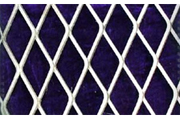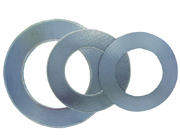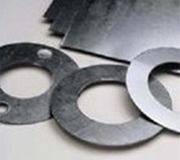
Kaxite Sealing manufactures the metal foil reinforced graphite gasket category at our Ningbo plant. The KXT-1020 is produced from 98% pure exfoliated graphite with a solid flat metal foil insert between the two graphite layers, held with a high-temperature adhesive bonding process rather than a perforated metal core. The result: the same 200 bar pressure rating as the tanged variant, but with both sealing faces staying flat and smooth — so the gasket seals against soft, machined, non-metallic or glass-lined flange faces without leaving scratch marks. UL certified. Sheet and finished gaskets produced in-house, not traded.
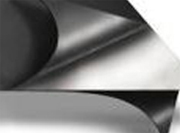
The solid flat foil core keeps both outer graphite surfaces perfectly flat — no tanged perforations or raised tangs to rake the flange face. That is why the KXT-1020 is the standard choice on soft, machined or glass-lined flanges.
Pressure rating, temperature range and pH range are identical to the tanged metal KXT-1010. The difference is what the core does: tanged locks the graphite for higher blow-out resistance; flat foil keeps the sealing faces smooth for face protection.
The foil is bonded with a high-temperature adhesive rather than mechanical interlocking. This is what allows the continuous flat foil layer to stay flat without perforations — no raised tangs to break through the graphite face.
Both carry the same 200 bar rating. What separates them is the flange face, not the pressure.
All four graphite gasket categories use the same 98% expanded graphite sealing material. The reinforcement decides the pressure rating and the correct flange face. Use the four-row table below to decide whether foil is the right core or whether tanged, mesh or pure graphite belongs on the job.
Shell and channel covers, floating-head covers and tube-sheet joints where the machined face is re-used across multiple gasket changes and must stay flat and scratch-free.
Machined steel or stainless bonnet faces that seal against a gasket under pressure and must not be scored each time the valve is serviced.
Flanges where the sealing face is non-metallic and cannot accept a perforated or tanged core against it, but the pressure still exceeds what pure graphite can hold.
Flanges with a controlled face finish where a reinforced gasket has to hold 200 bar without scuffing the machined sealing surface.
High-pressure, high-temperature steam lines with a machined face — foam core protects the finish that a tanged core would scratch.
Oval handholes, rectangular access covers and manifold gaskets cut to a DXF or PDF drawing, where the flat foil core lets the gasket keep its shape after cutting.
Confirm ASME B16.21 or DIN 2690, nominal size, pressure class, thickness, eyelet requirement and — critically for this model — the flange face material.
Standard sizes need no drawing. Non-standard shapes go through DXF/PDF review — bolt circle, gasket OD and eyelet positions confirmed before cutting.
Die cut or CNC cut to the confirmed dimensions, then eyelets fitted if ordered. Foil continuity checked after cutting — a damaged core is a rejected gasket.
Dimensional check against the ordered standard. Gaskets packed flat between rigid boards to protect the smooth sealing faces in transit.
Ningbo Kaxite Sealing Materials Co., Ltd. is a manufacturer, not a trading reseller — graphite sheet and finished gaskets are produced in-house. All four graphite gasket categories (pure, flat foil, tanged metal, metal mesh) are produced under one factory, so the reinforcement is recommended against the flange condition rather than against a catalogue. ASTM F36A compressibility and recovery data, material certificate, dimensional report and UL certificate reference available on request.
98% pure exfoliated graphite with a solid flat metal foil insert bonded between the two graphite sealing layers using a high-temperature adhesive process. Unlike the tanged metal gasket, the foil is continuous — no perforations, no raised tangs — so both outer sealing faces stay flat and smooth. That is what allows the gasket to be used on soft, machined or non-metallic flange faces at 200 bar.
Both carry the same 200 bar rating and the same −240 °C to +550 °C and pH 0–14 range, so pressure is not what separates them. The choice is made by the flange face. On a hardened steel face, the tanged metal KXT-1010 is more economical and handles pressure spikes better. On a soft, machined, non-metallic or glass-lined face — or any flange where the surface finish must stay scratch-free — the flat foil KXT-1020 is the correct choice.
Pressure rating is identical at 200 bar, recovery is identical at ≥20% and compressibility is identical at 15–35% to ASTM F36A. The mechanical difference is where the strength is concentrated. The tanged version locks the graphite into perforations, giving slightly higher blow-out resistance under severe pressure spikes. The flat foil version bonds the foil continuously, giving a smoother face. For most heat exchanger and valve bonnet service, the foil is more than strong enough and the smooth face is the more valuable property.
Yes. Non-standard flange, oval handhole, rectangular access cover and manifold gaskets are cut to a DXF or PDF drawing. Because the flat foil core must stay continuous after cutting, our engineers confirm the bolt circle, gasket OD and eyelet positions before cutting starts. Send the drawing with the inquiry for a feasibility check.
Material certificate and dimensional report against the ordered standard are available per shipment on request. ASTM F36A test report including compressibility and recovery can be supplied for critical service. UL certificate reference is available on request. Gaskets are packed flat between rigid boards to protect the smooth sealing faces.
Standard ASME and DIN sizes ship from stock sheet. Custom-cut shapes, eyelet versions and split gaskets are produced to order. For the MOQ and lead time on your specific size, send the standard, nominal size, thickness, eyelet requirement and quantity through the inquiry form — our engineers reply within one business day with pricing and delivery.
Include the gasket standard (ASME B16.21 or DIN 2690) or a drawing, the nominal size and pressure class, the thickness, the flange face material and the quantity. Our engineers reply within one business day with pricing, core confirmation and lead time.

Kaxite Sealing manufactures the KXT-1020 flat metal foil reinforced graphite gasket from expanded graphite with a solid flat metal foil insert bonded between the two graphite faces. The flat foil core keeps both sealing faces smooth, so the gasket is rated 200 bar (5× the pure graphite rating) while still sealing against soft, freshly machined, non-metallic or glass-lined flange faces without leaving scratch marks. Rated −240 °C to +550 °C, pH 0–14, with recovery ≥20% and compressibility 15–35% to ASTM F36A. Supplied with or without eyelets, cut to ASME B16.21 or DIN 2690 or to drawing. UL certified. Dimensional report and material certificate per shipment on request.