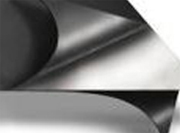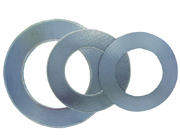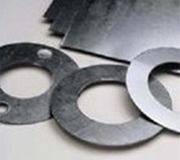
Kaxite Sealing manufactures the KXT-1030 metal mesh reinforced graphite gasket at our Ningbo plant, for the flanges where handling rigidity decides whether the gasket can be fitted at all. A woven stainless steel mesh core is mechanically interlocked with expanded graphite on both faces — no adhesives — giving the highest mechanical strength in the graphite gasket family. That means the gasket holds its shape across a DN2000+ manway cover, stays flat when carried vertically up to the flange, and still carries 200 bar at −240 °C to +550 °C. Cut to ASME B16.21 or DIN 2690, with or without eyelets, or to your drawing. UL certified.

| Property | Value | Standard / Note |
|---|---|---|
| Model | KXT-1030 | Kaxite metal mesh reinforced graphite gasket series |
| Construction | Woven stainless steel mesh core mechanically interlocked with expanded graphite on both faces | No adhesive — mechanical interlock |
| Density | 1.0 g/cm³ | Sheet density |
| Compressibility | 15 – 35 % | ASTM F36A |
| Recovery | ≥ 20 % | ASTM F36A |
| Pressure Rating | 200 bar | 5× the pure graphite KXT-1000 rating |
| Temperature Range | −240 °C to +550 °C | Same full range as the graphite family |
| pH Range | 0 – 14 | Full acid to alkaline service |
| Handling Rigidity | Highest in the family | Woven mesh holds shape under its own weight — no support carriage needed |
| Eyelets | Available with or without | Optional bolt-hole protection |
| Dimension Standard | ASME B16.21 / DIN 2690 | Custom sizes to drawing on request |
| Certification | UL certified | Certificate reference available on request |
The mesh reinforced gasket is a three-layer composite. The graphite sealing layers perform the actual seal; the woven mesh core is what makes the gasket hold its shape when it is picked up, carried, positioned and bolted.
The flange-side expanded graphite layer. Provides the temperature, chemical and sealing performance the gasket is specified for — identical graphite to the rest of the Kaxite family.
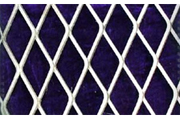
Woven wire mesh, interlocked with graphite during sheet forming. The mesh gives this gasket the highest mechanical strength and handling rigidity in the family. No adhesive — the bond is mechanical, so the gasket does not delaminate when the flange is opened or when it sees thermal cycling.
Second expanded graphite face against the mating flange. Both faces seal; the wire mesh core never touches the medium.
Size and handling condition, not pressure, are what separate the KXT-1030 from the rest of the family. The four size bands below show where the mesh core starts to pay back its extra cost.
Shell and head flanges on process vessels, columns and reactors where the gasket must stay flat across DN1000+ diameters before bolting.
Covers that are removed for inspection and re-fitted in the field, where a creased or folded gasket becomes a leak at the first pressure cycle.
Shell-side flanges where the gasket diameter is large enough that handling rigidity is the deciding property, not the sealing material.
If your flange is small but high-pressure, the Tanged Metal Reinforced Graphite Gasket KXT-1010 is more economical. If the flange face must stay scratch-free, the Flat Metal Foil Reinforced Graphite Gasket KXT-1020 is the right core. For non-standard shapes at the chemical or temperature limit where pressure stays below 40 bar, compare the Pure Graphite Gasket KXT-1000.
All four gaskets in the Kaxite graphite family share the same expanded graphite sealing material and cover the same −240 °C to +550 °C and pH 0–14 range. Selection comes down to pressure, flange face and handling condition. Walk the tree below from top to bottom.
Confirm ASME B16.21 or DIN 2690, nominal size, pressure class, thickness and eyelet requirement. For large vessel and manway gaskets, confirm split or one-piece format.
Standard ASME and DIN sizes need no drawing. Non-standard flanges, oval handholes and rectangular manway covers go through DXF/PDF review — bolt circle and gasket OD confirmed before cutting.
Die cut or CNC cut to the confirmed dimensions, then eyelets fitted if ordered. For DN1000+ gaskets, split gaskets or temporary carriers are fitted to make installation safe.
Dimensional check against the ordered standard. Gaskets packed flat between rigid boards to protect the sealing faces and keep the mesh core flat during transport.
The KXT-1030 is a three-layer composite: expanded graphite on both faces interlocked with a woven stainless steel mesh core. The graphite provides the temperature, chemical and sealing performance; the woven mesh provides the highest mechanical strength and handling rigidity in the graphite gasket family. No adhesives are used — the bond is mechanical interlocking during sheet forming, so the gasket does not delaminate when the flange is opened or after thermal cycling.
Size and handling condition drive the choice, not pressure. All three reinforced models carry 200 bar with the same temperature and pH range. Metal mesh is the right core when the gasket is larger than roughly DN400 or is a manway cover that must be carried and positioned vertically — the woven mesh holds the gasket flat under its own weight so it drops into the bolt pattern without creasing. Tanged is more economical on hardened faces at smaller sizes. Flat foil is the correct core when the flange face must stay scratch-free.
Pressure ratings are identical at 200 bar. The difference is mechanical strength in handling rather than pressure performance. The woven mesh core gives the highest handling rigidity in the family, so a DN1000 manway gasket cut from mesh will hold flat under its own weight, while the same size cut from tanged or flat foil will tend to sag and can crease before it reaches the flange. Choose mesh when handling rigidity is the deciding property.
Yes. Large-diameter manway covers are frequently specified as split gaskets so the gasket can be fitted without removing the whole cover. Split gaskets are cut, eyeleted and marked at the split point so the two halves locate correctly. Send the manway size and the split direction with the inquiry.
Material certificate and dimensional report against the ordered standard are available per shipment on request. ASTM F36A test report — including compressibility and recovery — can be supplied for critical service. UL certificate reference is available on request. Gaskets are packed flat between rigid boards to protect the sealing faces and keep the mesh core flat during transport.
Standard ASME and DIN sizes ship from stock sheet. Custom-cut shapes, split gaskets and eyelet versions are produced to order. For the MOQ and lead time on your specific size — particularly DN1000+ manway covers — send the standard, nominal size, thickness, split requirement and quantity through the inquiry form, and our engineers reply within one business day with pricing and delivery.
Include the gasket standard (ASME B16.21 or DIN 2690) or a drawing, the nominal size and pressure class, the thickness, the split requirement (for manway covers) and the quantity. Our engineers reply within one business day with pricing, type confirmation and lead time.