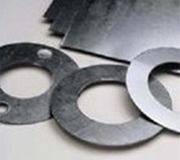
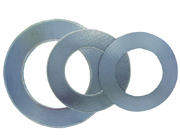
Kaxite Sealing manufactures the KXT-1010 tanged metal reinforced graphite gasket at our Ningbo plant, for flanges where the pure graphite gasket reaches its mechanical limit. A perforated metal core is mechanically bonded to expanded graphite on both faces — no adhesives, no separate layers — so the gasket handles 200 bar pressure and 5× the pressure rating of pure graphite without losing its temperature and pH range. Cut to ASME B16.21 or DIN 2690, with or without eyelets, or to your drawing. UL certified.

The specification below is the production control range for the KXT-1010. Because the tanged metal core changes the mechanical behaviour of the gasket, the properties most buyers care about are the ones that differ from pure graphite — pressure rating and recovery — not just the density and compressibility figures that look similar on paper.
| Property | KXT-1010 (this product) | KXT-1000 (pure graphite) | Standard / Note |
|---|---|---|---|
| Model | KXT-1010 | KXT-1000 | Kaxite graphite gasket series |
| Construction | Tanged metal core bonded to expanded graphite on both faces | 100% expanded graphite | Mechanical bond — no adhesive |
| Density | 1.0 g/cm³ | 0.7 – 1.0 g/cm³ | Sheet density |
| Compressibility | 15 – 35 % | 30 % | ASTM F36A |
| Recovery | ≥ 20 % | ≥ 10 % | ASTM F36A — 2× pure graphite |
| Pressure Rating | 200 bar | 40 bar | 5× pure graphite |
| Temperature Range | −240 °C to +550 °C | −240 °C to +550 °C | Identical full range |
| pH Range | 0 – 14 | 0 – 14 | Identical full range |
| Dimension Standard | ASME B16.21 / DIN 2690 / drawing | ASME B16.21 / DIN 2690 / drawing | Same standards, same cutting service |
| Eyelets | Available with or without | Not applicable | Tanged gasket feature |
| Certification | UL certified | UL certified | Certificate reference on request |
The tanged metal reinforced gasket is not three separate layers pressed together. It is a single composite: the graphite is driven into the perforations of the metal core while the sheet is formed, so the graphite and the metal are mechanically interlocked without any adhesive. That is why the gasket holds its shape during handling and does not delaminate under heat.
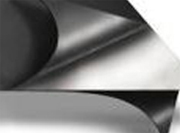
High-purity expanded graphite on the flange side. This is the sealing surface — it conforms to flange imperfections and provides the chemical and temperature resistance the gasket is specified for.
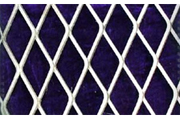
Perforated metal sheet with tanged (roughened) surface. The perforations and tanged texture are what the graphite locks into — this is the layer that provides blow-out resistance and crushing resistance under high bolt load.
Second expanded graphite face for the mating flange. Both faces seal; the metal core is not exposed to the medium, only to the flange compression.
All four types in our graphite family use the same expanded graphite sealing material; what changes is the reinforcement. Selecting the wrong reinforcement is the most common cause of a gasket failure that is blamed on the graphite itself. The comparison below is the selection our engineers walk through with buyers who are not yet fixed on a type.
| Selection Factor |
Tanged Metal Reinforced KXT-1010 |
Metal Foil Reinforced | Metal Mesh Reinforced |
Pure Graphite KXT-1000 |
|---|---|---|---|---|
| Core type | Perforated tanged metal | Solid metal foil insert | Wire mesh insert | No reinforcement |
| Pressure rating | 200 bar | High — usually similar to tanged | Highest in the family | 40 bar |
| Blow-out resistance | Strong — the perforations lock the graphite | Moderate — foil provides a barrier not a lock | Strong — mesh interlocks the graphite | Low — no reinforcement |
| Handling rigidity | High — holds shape without support | Moderate | Highest — suited to large diameter gaskets | Low — large gaskets may need a carrier |
| Effect on flange face | Standard — the graphite face seals | Gentle — good for soft or delicate sealing faces | Standard | Standard |
| Cutting flexibility | Good — cut with knife or die | Good | Moderate — mesh resists cutting | Easiest — knife or die, any shape |
| Best fit | High-pressure flanges, pressure spikes, thermal cycling, high bolt load | Heat exchanger and valve bonnet flanges with soft sealing faces | Large vessel flanges, manway covers, oversized gaskets | Non-standard shapes at chemical or temperature extremes |
Tanged gaskets are more sensitive to cutting and handling than pure graphite because the metal core must not be damaged during the cut. The four steps below are what happens between your inquiry and the shipped gasket.
Confirm ASME B16.21 or DIN 2690, nominal size, pressure class, thickness and whether eyelets are required. Non-standard shapes go straight to the drawing step.
Send a DXF, PDF or physical sample. For non-standard flanges, our engineers confirm the bolt circle, gasket OD and eyelet positions before cutting starts.
Die cut or CNC cut to the confirmed dimensions, then eyelets are fitted if ordered. Core integrity is checked after cutting — a damaged core is a rejected gasket.
Dimensional check against the ordered standard, material certificate and ASTM F36A test report on request. Gaskets packed flat between rigid boards to protect the sealing faces.
Boiler and superheater flanges above the pure graphite pressure limit, where blow-out risk rules out an unreinforced gasket.
Hydrocarbon and hydrogen flanges that combine high pressure with thermal cycling between shutdown and operating temperature.
Acid and alkaline service across the full pH 0–14 range, at pressures that would deform a pure graphite gasket.
Flanges that see pressure spikes during start-up and shutdown, where the gasket has to recover without losing the seal.
Gaskets that must hold shape during handling and fitting, or that will be disassembled for inspection between service intervals.
Turbine auxiliary and combined-cycle steam flanges where high pressure and high temperature occur together.
For the rest of the sealing package on the same flange, our Tanged Metal Reinforced Graphite Gaskets category covers the full family, and the Products overview lists every gasket type we manufacture.
It is a composite gasket made from expanded graphite mechanically bonded to a perforated metal core with a tanged (roughened) surface on both faces. The tanged surface and perforations lock the graphite into the metal, so the gasket gets the temperature and chemical resistance of graphite together with the mechanical strength of a metal insert. No adhesives are used — the bond is mechanical.
Temperature range (−240 °C to +550 °C) and pH range (0–14) are identical, but the pressure rating and recovery are not. The tanged metal reinforced gasket is rated at 200 bar versus 40 bar for pure graphite, and recovers ≥20% versus ≥10% for pure graphite. It is also more rigid during handling and fitting, which matters for large or awkward gaskets.
Eyelets are metal rings fitted into the bolt holes of the gasket to protect the graphite from bolt-head crushing and to improve handling. They are optional — the gasket seals without them. Eyelets are commonly specified on high-pressure flanges and on gaskets that will be reused, and they are available on the KXT-1010 on request.
Yes. Non-standard flange, oval handhole, rectangular access cover and manifold gaskets are cut to a DXF or PDF drawing. Because the metal core must not be damaged during cutting, we confirm the bolt circle, gasket OD and eyelet positions before cutting starts. Send the drawing with the inquiry for a feasibility confirmation.
Material certificate and dimensional report against the ordered standard are available per shipment on request. ASTM F36A test report — including compressibility and recovery — can be supplied for critical service. UL certificate reference is available on request.
Standard ASME and DIN sizes ship from stock sheet. Custom-cut shapes, eyelet versions and split gaskets are produced to order. For the MOQ and lead time on your specific size, send the standard, nominal size, thickness, eyelet requirement and quantity through the inquiry form — our engineers reply within one business day with pricing and delivery.
Include the gasket standard (ASME B16.21 or DIN 2690) or a drawing, the nominal size and pressure class, the thickness, whether you need eyelets, and the quantity. Our engineers reply within one business day with pricing, type confirmation and lead time.