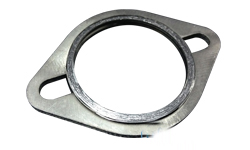
Gasket Materials are the critical, often unseen components that form a reliable seal between two or more mating surfaces. Their primary function is to prevent leakage of fluids or gases, withstand system pressures and temperatures, and compensate for imperfections in flanges or surfaces. Choosing the correct gasket material is not merely a procurement decision; it is a fundamental engineering choice that directly impacts system safety, efficiency, operational longevity, and maintenance costs. At Kaxite Sealing, with decades of specialization in fluid sealing technology, we understand that the “best” gasket material does not exist in a vacuum. It is defined by the specific application's demands. This comprehensive guide delves into the core materials, their properties, selection criteria, and answers to common questions, providing you with the knowledge to make an informed sealing decision.
### The Essential Role and Core Functions of Gasket Materials
A gasket must perform several simultaneous functions under challenging conditions:
* **Sealing:** Creates a tight barrier to prevent the escape or ingress of liquids, gases, or environmental contaminants.
* **Compensation:** Fills microscopic irregularities and voids on flange surfaces to achieve a perfect seal.
* **Pressure Resistance:** Must maintain seal integrity under internal system pressure and the compressive load of bolting.
* **Temperature Tolerance:** Must withstand operational temperatures without degrading, melting, embrittling, or losing elastic properties.
* **Chemical Compatibility:** Must resist corrosion, swelling, or chemical attack from the media being sealed.
* **Compressibility & Recovery:** Needs to compress under bolt load to flow into surface imperfections and exhibit some recovery (resilience) to maintain seal during thermal cycles or pressure fluctuations.
Failure in any of these areas can lead to leaks, product loss, safety hazards, environmental issues, and unplanned downtime.
### Primary Categories of Gasket Materials
Gasket materials are broadly classified into three main categories, each with sub-types tailored for specific service conditions.
#### 1. Non-Metallic Materials
These are typically soft, compliant materials, often used with low to medium pressure flanges (e.g., ANSI 150/300).
* **Compressed Non-Asbestos (CNA) / Aramid Fiber:** The industry standard for general service. Made from aramid fibers (like Kevlar®), synthetic rubbers, and fillers. They offer excellent chemical and temperature resistance, good sealability, and are suitable for a wide range of media including water, steam, oils, and many chemicals.
* **Rubber Elastomers (NBR, EPDM, FKM/Viton®, Silicone):** Used for molded rubber gaskets or sheet cut gaskets.
* **NBR (Nitrile):** Excellent resistance to oils, fuels, and aliphatic hydrocarbons.
* **EPDM:** Superior resistance to weather, ozone, steam, and polar fluids.
* **FKM (Fluorocarbon/Viton®):** Exceptional resistance to high temperatures, oils, acids, and many aggressive chemicals.
* **Silicone:** Wide temperature range flexibility, good for food-grade and static sealing applications.
* **Polytetrafluoroethylene (PTFE):** Known for its near-universal chemical inertness and excellent anti-stick properties. Used as pure PTFE sheet, expanded PTFE (ePTFE), or as a filler in composite materials. It has low cold flow tendency.
* **Graphite:** Excellent for high-temperature services (up to 450°C / 842°F in oxidizing atmospheres, higher in inert gases). It offers great thermal conductivity and recovery but requires careful handling as it is brittle.
#### 2. Semi-Metallic Materials
These combine the sealability of a soft filler with the strength and temperature resistance of a metal core or skeleton. They are used for medium to high-pressure/temperature applications.
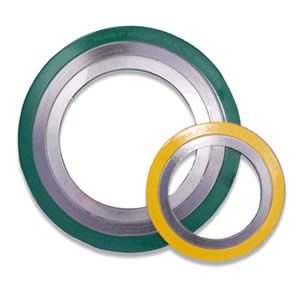
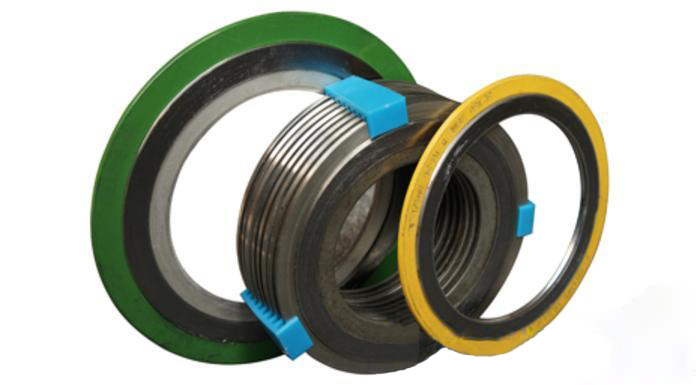
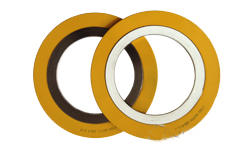
* **Spiral Wound Gaskets:** Arguably the most widely used high-performance gasket. They consist of a pre-formed V-shaped metal strip (stainless steel, Monel, etc.) wound alternately with a soft filler material (graphite, PTFE, mica). This structure provides excellent resilience and sealing.
* **Metal Jacketed Gaskets:** Feature a soft filler (asbestos-free or graphite) fully enclosed in a thin metal jacket (often stainless steel or soft iron). They provide good compression and are used for heat exchangers, valves, and high-pressure connections.
* **Kamprofile Gaskets:** A solid metal core with concentric serrations (grooves) on both faces. The serrations are filled with a soft sealing material (usually graphite or PTFE). They offer high mechanical strength and excellent sealing performance for severe service conditions.
#### 3. Metallic Materials
Used for the most extreme pressures, temperatures, and in solid metal ring-type joints (RTJs). They rely on the yield strength of the metal to create a seal.
* **Soft Irons, Low Carbon Steels**
* **Stainless Steels (304, 316)**
* **Alloy Steels (Monel, Inconel, Titanium)**
### Critical Material Properties & Selection Parameters
Selecting a gasket material requires cross-referencing application data with material property sheets. Below is a comparative table of common Kaxite Sealing gasket materials.
**Comparative Properties of Common Kaxite Sealing Gasket Materials**
| Material Type |
Max Temp (°C / °F) |
Max Pressure (Bar / PSI) |
pH Range |
Key Strengths |
Typical Applications |
| CNA / Aramid Fiber |
290°C / 554°F |
140 / 2030 |
2 - 12 |
Wide chemical compatibility, cost-effective, good recovery. |
General industrial piping, water, steam, hydrocarbons. |
| Compressed Graphite |
450°C / 842°F* |
160 / 2320 |
0 - 14 |
Exceptional high-temp performance, excellent thermal conductivity. |
Heat exchangers, boiler manways, high-temp chemical processes. |
| Expanded PTFE (ePTFE) |
260°C / 500°F |
100 / 1450 |
0 - 14 |
Universal chemical resistance, creep resistant, very clean. |
Aggressive chemicals, pharmaceutical, food & beverage. |
| Nitrile Rubber (NBR) |
100°C / 212°F |
20 / 290 |
5 - 10 |
Excellent oil and fuel resistance, good compression set. |
Hydraulic systems, fuel handling, automotive. |
| FKM / Viton® |
230°C / 446°F |
30 / 435 |
1 - 12 |
Outstanding chemical & high-temp resistance for an elastomer. |
Chemical processing seals, aerospace, sour oil & gas. |
| Spiral Wound (SS304/Graphite) |
500°C / 932°F |
250+ / 3625+ |
0 - 14 (Filler Dependent) |
Superior resilience, handles thermal cycling, high P/T. |
Refinery piping, power generation, high-pressure vessels. |
*In oxidizing atmospheres. Consult Kaxite Sealing for inert service.
**Key Selection Factors Checklist:**
* **Fluid Media:** What chemical is being sealed? Check chemical resistance charts.
* **Concentration & State:** Is it a concentrated acid, dilute solution, vapor, or gas?
* **Temperature:** Both continuous operating and any peak/cyclical temperatures.
* **Pressure:** Steady-state and any potential pressure surges.
* **Flange Type & Condition:** Raised face, flat face, RTJ? Surface finish (e.g., 125-250 µin RA)? Any pitting or damage?
* **Bolting:** Bolt material, size, and available torque. This determines available seating stress.
* **Regulatory & Industry Standards:** FDA, USP Class VI, NSF, API, TA-Luft, NORSOK, etc.
### Gasket Materials: Frequently Asked Questions (FAQ)
**Q: What is the most important factor when selecting a gasket material?**
**A:** There is no single "most important" factor; it is the **intersection of chemical compatibility, temperature, and pressure**. Chemical compatibility is paramount—if the material degrades in the media, all other properties are irrelevant. Always start with chemical resistance, then verify temperature and pressure limits.
**Q: Can I use a rubber gasket for a high-temperature steam application?**
**A:** Generally, no. Standard elastomers like NBR or EPDM will rapidly degrade at high steam temperatures. For steam services, materials like compressed non-asbestos (CNA), graphite, or spiral wound gaskets with graphite filler are standard choices. Specific high-temperature steam-rated EPDM may be used for lower-pressure saturated steam.
**Q: What does "compression set" mean, and why is it important?**
**A:** Compression set is a material's tendency to permanently deform and not return to its original thickness after prolonged compression under load. A low compression set (expressed as a low percentage) is critical for long-term sealing performance, especially in systems with thermal cycling, as it indicates the material retains its resilience and ability to maintain bolt load.
**Q: Why do spiral wound gaskets have different windings and filler materials?**
**A:** The winding density (number of plies per inch) and the metal/filler combination are engineered for specific pressure classes and media. A dense winding with thick metal strip suits higher pressures. Graphite filler is for high temperatures, PTFE for aggressive chemicals, and mica for very high-temperature oxidizing environments. Kaxite Sealing engineers can specify the optimal construction for your service.
**Q: How do I handle and store gasket materials correctly?**
**A:** Proper handling is crucial. Store materials flat in a cool, dry, dark place away from UV light, ozone sources, and extreme temperatures. Keep them in original packaging until use. Graphite and PTFE sheets should be handled with care to avoid creasing or tearing. Never hang gaskets on hooks, as this can cause distortion.
**Q: What are the signs of gasket material failure?**
**A:** Visible leakage is the most obvious sign. Other indicators include extrusion of the gasket material from the flange gap, significant compression (thinning), surface cracking, blistering, hardening, or chemical swelling. Post-removal inspection of a failed gasket can often diagnose the root cause (e.g., chemical attack, overheating, insufficient bolt load).
**Q: Can Kaxite Sealing provide custom-formulated gasket materials?**
**A:** Yes. While we stock a vast range of standard materials, our technical team specializes in developing custom-compounded materials to solve unique challenges involving exotic chemicals, extreme temperature/pressure combinations, or specific regulatory requirements. Contact our engineering department with your application details.
**Q: What is the difference between a gasket material and a gasket?**
**A:** The **gasket material** is the raw sheet, roll, or spool from which a **gasket** is fabricated. The gasket is the finished, cut-to-shape component ready for installation. Kaxite Sealing provides both: we supply high-quality raw materials to gasket cutters and also manufacture precision-finished gaskets from our own material stock to ensure traceability and performance.