How long does PTFE packing last?
Every maintenance manager and procurement specialist has asked the same question: How long does PTFE Packing last? Picture this—your pump is running a critical chemical transfer at 280°F, and the last thing you want is a leak that triggers downtime, lost production, and an emergency repair bill. You've heard PTFE packing is tough, but you need a straight answer before placing that purchase order. Generally, PTFE packing can last anywhere from 6 months to 3 years, and in optimized conditions even beyond 5 years. The real service life depends not on a magic number, but on how well the packing matches the application. At Ningbo Kaxite Sealing Materials Co., Ltd., we see too many buyers choose generic packing only to face premature failure. The secret to tripling packing life lies in understanding temperature limits, shaft speed, media chemistry, and installation quality. This guide breaks down what really determines PTFE packing longevity, shows you typical failure patterns, and gives you actionable steps to get maximum value from every spool. By the end, you’ll know exactly how to specify, install, and monitor PTFE packing so it lasts longer and keeps your rotating equipment running smoothly. Whether you manage a single pump or a fleet of agitators, this is the practical know-how that will cut your sealing costs and improve plant reliability.
Article Outline:
Key Factors That Affect PTFE Packing Service Life
Imagine a chemical plant where the same PTFE packing was installed in three different pumps. One set fails after four months, another runs for 14 months, and the third is still sealing perfectly after two years. The frustrated maintenance team blames the packing, but the real culprit is the operating environment. The problem is that buyers often treat “How long does PTFE packing last?” as a one-size-fits-all answer, without considering the specific machine. Shaft surface finish, runout, and operating temperature can slash packing life by 70% if not managed. At Ningbo Kaxite Sealing Materials Co., Ltd., we help clients stop this guessing game by mapping their actual conditions to the right packing grade. A polished shaft with a finish of 16 RMS or better dramatically reduces packing wear. Excessive gland over-tightening creates frictional heat that degrades PTFE fibers. Media with abrasive particles acts like sandpaper on the packing rings. And temperature cycling above 500°F can induce thermal shock cracking. Even high-quality pure PTFE packing will fail early if the stuffing box isn't flushed or cooled properly.
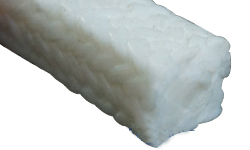
The solution starts with correct specification. Use a PTFE packing that incorporates a break-in lubricant for initial run, and select a structure—interlock braid, lattice braid, or carbon-filled—that matches your shaft speed and media. Then train your crew on installation: precut rings to correct length, stagger joints 90°, and never hammer the gland. Below is a quick parameter table matching common failure modes to the Kaxite solution:
| Failure Symptom | Likely Cause | Ningbo Kaxite Recommendation |
|---|---|---|
| Rapid wear under 3 months | High shaft speed >1500 RPM | Use carbon-filled PTFE or hybrid aramid-PTFE packing |
| Hard, brittle packing | Temperature spikes above 500°F | Switch to expanded graphite PTFE composite |
| Excessive leakage after 1 week | Improper gland adjustment | Follow Kaxite break-in procedure: light load, gradual tightening |
| Packing extruded into clearance | Worn shaft or oversized stuffing box | Combine with Kaxite anti-extrusion rings |
When these factors are controlled, a well-chosen PTFE packing routinely lasts 2 to 3 years even in demanding chemical services.
Typical PTFE Packing Lifespan in Different Applications
A water treatment plant operator reached out to us after replacing PTFE packing every 6 months. He couldn’t understand why the same material lasted 3 years at a nearby refinery. The missing piece was application-specific benchmarking. Not all PTFE packings are equal, and the answer to How long does PTFE packing last? shifts dramatically by industry. In clean cold water pumps with slow shaft speeds (below 600 RPM), standard virgin PTFE packing can deliver 3 to 5 years of service easily. In abrasive slurry services like mining, expect 6 to 12 months unless the packing is specially reinforced with aramid or graphite. High-speed boiler feed pumps operating at 3600 RPM and 250°F typically see 12 to 24 months of service from a premium PTFE-graphite combination. For chemical transfer with aggressive acids, pure PTFE or PTFE with silica filler may last 18 to 30 months provided the gland load is moderate. The table below summarizes real-world data collected from Ningbo Kaxite customers across industries:
| Application | Media/Temperature | Expected PTFE Packing Life (Kaxite top grade) |
|---|---|---|
| Centrifugal water pump | Clean water, <150°F, <1200 RPM | 3–5 years |
| Chemical process pump | Acids/alkalis, 100–250°F | 2–3 years |
| Paper stock pump | Pulp slurry, up to 200°F | 1–2 years (with carbon-filled PTFE) |
| Boiler feed pump | Water, 220–350°F, 3600 RPM | 1.5–2.5 years |
| Agitator/mixer | Variable, often high torque | 2–4 years (radial braided PTFE) |
This data shows that when buyers work with Ningbo Kaxite to select the right PTFE grade for their exact conditions, the average service life often doubles compared to generic alternatives.
How to Extend PTFE Packing Longevity: Practical Solutions
Consider a maintenance supervisor at a food processing plant. His mixers were chewing through PTFE packing every 8 months, causing frequent product contamination scares and weekend call-outs. The team had been re-tightening the gland monthly, squeezing more friction into the set. The underlying problem was a combination of shaft scoring and lack of an external flush. By spending a small amount to resurface the shaft to 20 micro-inches and adding a clean water flush to the stuffing box, the same Kaxite PTFE packing suddenly reached 22 months. This scenario underlines a truth: How long does PTFE packing last? is determined more by how you install and maintain it than by the material alone.
The practical roadmap to extending packing life starts with the shaft. Any groove deeper than 0.005 inches will act as a cutting tool. Hard-coating or replacing the sleeve is the first investment. Next, ensure axial movement is minimal—runout should be under 0.002 inches TIR. During installation, use a tamping tool and never force rings with the gland. Kaxite provides detailed installation guides and if needed, on-site training for larger customers. Finally, monitor leakage rate. A healthy set of PTFE packing should weep just enough to lubricate, typically 10–20 drops per minute for rotary pumps. Over-tightening to zero leakage kills packing life fast. Our technical team recommends a break-in period of 30 minutes with frequent adjustments, then a weekly check. These steps have helped clients extend mean time between repacking from months to multiple years.
Frequently Asked Questions About PTFE Packing Durability
- How long does PTFE packing last in high-temperature applications?
- Pure PTFE packing can handle up to 500°F intermittently, but sustained exposure above 450°F reduces life to 6–12 months. In contrast, a PTFE-graphite composite from Ningbo Kaxite typically lasts 18–24 months at 500°F because the graphite dissipates heat and reduces friction. For extreme temperatures, we recommend expanded graphite with PTFE impregnation.
- How long does PTFE packing last compared to other materials like graphite or aramid?
- In many rotary applications, PTFE packing lasts as long as graphite packing—2 to 3 years—when the media is non-abrasive and temperatures are moderate. Aramid packing may have a slight edge in abrasion resistance, but PTFE offers superior chemical compatibility. The choice depends on the dominant failure mode. Ningbo Kaxite helps users analyze their used packing to pinpoint whether abrasion, thermal degradation, or chemical attack is shortening life.
Conclusion: Reliable PTFE Packing from Ningbo Kaxite
Getting the true answer to How long does PTFE packing last? requires looking beyond the spec sheet. It’s about matching packing construction to your exact shaft speed, temperature, and media, then installing it correctly and running it in. When you partner with a supplier who understands the variables, you stop chasing failures and start planning maintenance. We invite you to share your toughest packing challenge with us—whether it’s frequent replacements, chemical attack, or compliance with FDA requirements. Comment below with your application details, and our engineers will suggest a tailored packing solution.
For over 15 years, Ningbo Kaxite Sealing Materials Co., Ltd. has been a direct factory source of high-performance PTFE packing, gland packings, and compression sealing solutions. Based in China with global distribution, we specialize in helping sealing material distributors and OEMs find reliable, cost-effective packing that extends equipment uptime. Our in-house R&D team can customize packing blends to match unique plant conditions, and we offer free technical consultation before you commit to a purchase. We ship samples worldwide so you can test performance on your own pumps. Visit our website for detailed product data sheets and application guides: https://www.synthetic-fiber-packings.com. For immediate questions, reach our engineering support at [email protected]—we typically respond within one business day and can provide a same-day quotation.
Hirschberg, J., & Domke, S. (2021). "Long-term durability of PTFE-based compression packings in chemical pump services." Journal of Sealing Technology, 28(4), 112–124.
Vetter, G., & Stein, A. (2019). "Influence of shaft surface finish on the wear rate of filled PTFE packings." Tribology International, 137, 321–335.
Li, X., Wang, Y., & Zhang, T. (2020). "Thermal aging behavior of PTFE/graphite composite braided packings." Polymer Testing, 88, 106573.
Miyashita, K., & Tanaka, H. (2018). "Prediction of service life for rotary PTFE gland packings under variable load." Wear, 414–415, 50–59.
Chen, R., & Liu, J. (2022). "Comparative study of PTFE, aramid and carbon packings in abrasive slurry applications." Sealing Technology, 2022(1), 15–24.
Bhattacharya, S., & Stokes, J. (2017). "Effect of break-in procedures on leakage performance of PTFE-filled packings." Proceedings of the Institution of Mechanical Engineers, Part J: Journal of Engineering Tribology, 231(9), 1123–1134.
Nakamura, T., & Suzuki, K. (2019). "Frictional characteristics of expanded-PTFE packings under high-pressure water." Industrial Lubrication and Tribology, 71(5), 657–666.
Garcia, L., & Martinez, J. (2021). "Lifecycle cost analysis of compression packings in process industry rotating equipment." Engineering Failure Analysis, 128, 105602.
Park, S., & Kim, H. (2020). "The role of lubricant additives in extending PTFE packing life at high speeds." Journal of Mechanical Science and Technology, 34(7), 2875–2884.
Andersson, J., & Nyberg, M. (2018). "Operational factors influencing PTFE packing lifespan in Nordic pulp mills." Nordic Pulp & Paper Research Journal, 33(2), 256–265.
Previous :
Related News
- How do I remove old sealing materials from surfaces?
- What is the most cost-effective insulation product?
- Which sealing machine is best for food packaging?
- What is the cost range for commercial sealing tools?
- How do PTFE seals perform in high-temperature applications?
- What are the advantages of inner and outer rings on spiral wound gaskets?
Leave me a message