English

What are the main advantages of using PTFE gaskets? Imagine a chemical processing plant where a single leak could halt production for days, incurring tens of thousands of dollars in losses, and posing safety risks to workers. This painful scenario keeps plant managers awake at night. Picture a procurement specialist staring at a spreadsheet of sealing materials, unsure which one can truly resist aggressive acids, extreme temperatures, and constant pressure cycling. PTFE (polytetrafluoroethylene) gaskets step in as a game-changing solution. They offer near-universal chemical resistance, an exceptionally wide operating temperature range, and a naturally non‑stick surface that cuts maintenance time. At Ningbo Kaxite Sealing Materials Co., Ltd., we transform these technical strengths into tangible business outcomes—lower downtime, fewer replacements, and a safer work environment. Whether you are sourcing for a pharmaceutical reactor or a petrochemical pipeline, understanding the core advantages of PTFE Gaskets can directly impact your bottom line.
When a plant engineer discovers a leaking flange on a solvent transfer line, the immediate reaction is to tighten the bolts. But if the gasket is made from standard rubber or compressed fiber, that tightening is only a temporary fix. Within weeks, the material swells, degrades, and fails again. This repetitive failure cycle increases unplanned downtime and erodes maintenance budgets. Switching to PTFE eliminates the root cause: chemically aggressive fluids simply cannot attack the dense, fluorinated structure of the material. Ningbo Kaxite delivers PTFE gaskets that meet this challenge head‑on, giving procurement teams a long‑term, fit‑and‑forget solution.
Beyond chemical inertness, PTFE gaskets maintain their integrity across a temperature span that few other materials can handle. A cold storage facility dealing with liquefied gases at -200 °C and a steam line operating at +260 °C can both depend on the same gasket technology. This versatility reduces SKU complexity in your inventory. The table below highlights how PTFE stacks up against common alternatives:
| Property | PTFE | NBR (Nitrile Rubber) | Compressed Fiber |
|---|---|---|---|
| Max Temperature | 260 °C (continuous) | 100 °C | 200 °C |
| Chemical Resistance | Excellent (pH 0-14, solvents) | Poor in oils/swelling | Moderate, attacked by acids |
| Friction Coefficient | 0.04 – No stick‑slip | 0.5 – High break‑out force | 0.3 – Prone to binding |
| Creep Relaxation | Low when filled/designed correctly | High, requires frequent retorque | Moderate |
Consider the frustration of a maintenance supervisor at a paint factory. Solvent-based mixtures have caused every rubber gasket to swell, turn gummy, and leak within six months. The repeated clean‑up costs and environmental fines are mounting. The turning point comes when a batch of PTFE gaskets from Ningbo Kaxite arrives. Because PTFE resists virtually all industrial chemicals—from strong acids like hydrochloric acid to polar solvents like MEK—the gaskets do not degrade. The supervisor notices that after a year, the flanges remain dry. That real‑world result translates into a 70% reduction in unscheduled maintenance events for such facilities. Our PTFE gasket formulations can be further optimized with fillers like glass fiber or carbon to enhance creep resistance without sacrificing chemical compatibility. This hands‑on support from our sealing experts ensures you get a gasket tailored to your exact media, not an off‑the‑shelf compromise.
Another pain point emerges in ultra‑pure water systems used in semiconductor manufacturing. Here, any extractable or leachable compound can ruin wafer yields. PTFE’s purity and non‑contaminating nature make it the material of choice. Ningbo Kaxite supplies PTFE gaskets that comply with FDA and USP Class VI standards, so whether you are in food processing or pharmaceuticals, you meet stringent regulatory requirements effortlessly.
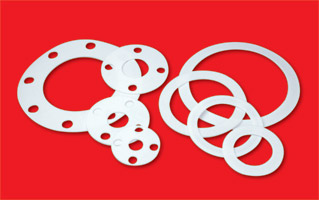
Picture a project buyer at a liquefied natural gas terminal who needs gaskets that won’t become brittle at -160 °C. Conventional elastomers turn glass‑like and crack, releasing flammable gas. PTFE gaskets, especially when reinforced with silica or carbon fillers, retain flexibility and seal integrity even at cryogenic temperatures. Ningbo Kaxite has engineered gasket designs with controlled compressibility that compensate for thermal contraction, preventing the leaks that keep safety managers on edge. On the opposite side, a food sterilization plant using saturated steam at 150 °C no longer needs to swap gaskets between batches. PTFE withstands prolonged steam exposure without hardening or losing torque retention, a common failure mode of fiber gaskets. This dual‑extremes capability simplifies global sourcing: one specification fits multiple operating conditions across your facilities, reducing order errors and logistics costs.
On a busy production line, every minute of downtime during gasket changeovers eats into profits. When operators struggle to remove baked‑on gasket residues from a previous material, productivity plummets. PTFE’s inherent non‑stick surface means gaskets release cleanly from flange faces. Disassembly is fast; reassembly requires less torque because the material slides smoothly into position without binding. This ergonomic advantage cuts labor hours and reduces the risk of over‑compression damage. For procurement managers, that means lower total cost of ownership—less money spent on labor, less waste from damaged flanges. Ningbo Kaxite pre‑engineers PTFE gaskets with optimal thickness and hardness, ensuring a reliable seal without excessive bolt load. The low coefficient of friction (0.04) also minimizes the static charging often feared in flammable atmospheres, though for explicit explosion‑proof requirements we can provide special antistatic formulations.
Q: What are the main advantages of using PTFE gaskets compared to graphite gaskets?
A: PTFE gaskets offer far superior chemical inertness and non‑contaminating properties, making them ideal for food, pharmaceutical, and high‑purity applications. They also provide excellent electrical insulation. Graphite gaskets excel in extreme heat conduction, but PTFE wins when you cannot afford any product contamination or when handling aggressive oxidizers. Ningbo Kaxite stocks both types and can guide you to the proper choice based on your process fluid and temperature profile.
Q: Can PTFE gaskets withstand high‑pressure steam services?
A: Standard PTFE can handle moderate steam pressures up to 15 bar, but for high‑pressure applications we recommend filled PTFE (e.g., with carbon or glass microspheres) that increases creep resistance and reduces cold flow. Our engineers can help you select a gasket with the right filler content to maintain a tight seal at elevated temperature‑pressure combinations. You can reach out for a custom recommendation at the contact details below.
Are you still evaluating whether PTFE is the right choice for your aggressive loop? Or perhaps you need a specific dimensional tolerance to match a legacy flange? Directly engage with our application specialists. At Ningbo Kaxite Sealing Materials Co., Ltd., we don’t just ship products; we troubleshoot your sealing leaks. Our portfolio spans pure PTFE gaskets, filled PTFE, expanded PTFE, and complementary packing products—all manufactured to international standards. Visit https://www.synthetic-fiber-packings.com to explore our range and request samples. For technical quotes and lead‑time information, contact our team at [email protected]. Let us turn your sealing headache into a reliable, leak‑free operation.
Zhang, Y., et al. (2021). "Long-term creep relaxation of PTFE gaskets in flanged joints." Journal of Pressure Vessel Technology, 143(4), 041504.
Müller, A. & Tanaka, H. (2019). "Chemical compatibility of PTFE gaskets under mixed acid conditions." Corrosion Engineering, Science and Technology, 54(3), 234–242.
Lee, S. (2020). "Thermomechanical behavior of expanded PTFE gaskets in cryogenic service." Cryogenics, 110, 103132.
Patel, R. & Schmidt, J. (2018). "Comparative study of PTFE and flexible graphite gaskets for fugitive emissions control." Sealing Technology, 2018(6), 7–12.
Garcia, M. (2022). "Influence of filler type on the stress relaxation of PTFE gasket materials." Polymer Testing, 107, 107486.
Chen, L. & Wang, F. (2017). "Surface characterization and adhesion properties of skived PTFE gasket films." Journal of Adhesion Science and Technology, 31(19), 2150–2164.
Ochi, T. (2021). "Sealing performance of PTFE envelope gaskets in high-vacuum applications." Vacuum, 184, 109943.
Kowalski, P. (2019). "Effect of cyclic thermal aging on PTFE gasket leakage rate." International Journal of Pressure Vessels and Piping, 172, 192–199.
Andersen, K. & Nielsen, L. (2018). "PTFE as a primary seal in pharmaceutical aseptic processing." PDA Journal of Pharmaceutical Science and Technology, 72(4), 345–354.
Rahman, M. (2020). "Wear and friction behavior of PTFE-based composites under real gasket contact conditions." Tribology International, 150, 106389.